Home / Insights / Website speed
Website speed: how fast should your site be, and what slow costs you
Published August 2026 · By Manon Vernay
Someone taps your link while they're waiting for a coffee. Three seconds later the screen's still white. They go back to Google and tap the next business.
You never find out that happened. There's no notification for the enquiry you didn't get. That's what makes website speed so easy to leave alone for three years.
The 60-second test
Go to pagespeed.web.dev, paste in your website address, press Analyse. It's free, it's Google's own tool, and nobody emails you afterwards.
Read the Mobile tab first. Desktop scores are flattering, because desktop machines are fast and sitting on wifi. Your customers are on a phone, on mobile data, one-handed, mildly impatient.
You get four scores out of 100. Green is 90 and above, orange is 50 to 89, red is under 50.
What the four scores mean
Performance. How quickly your page becomes usable. This is the one everybody means when they say speed.
Accessibility. Whether someone who can't see your site, or can't use a mouse, can still get around it. One in five Australians lives with disability, so it's not a small group. It has its own post.
Best Practices. Basic hygiene. Is your site secure, is anything on it broken.
SEO. A technical once-over. Can Google read the page properly.
Worth being clear about that last one, because people sell it the other way round. A 100 SEO score here means the plumbing works. Getting found is a separate job, and anyone quoting you the score as a ranking is being creative.
Where we landed on our own site
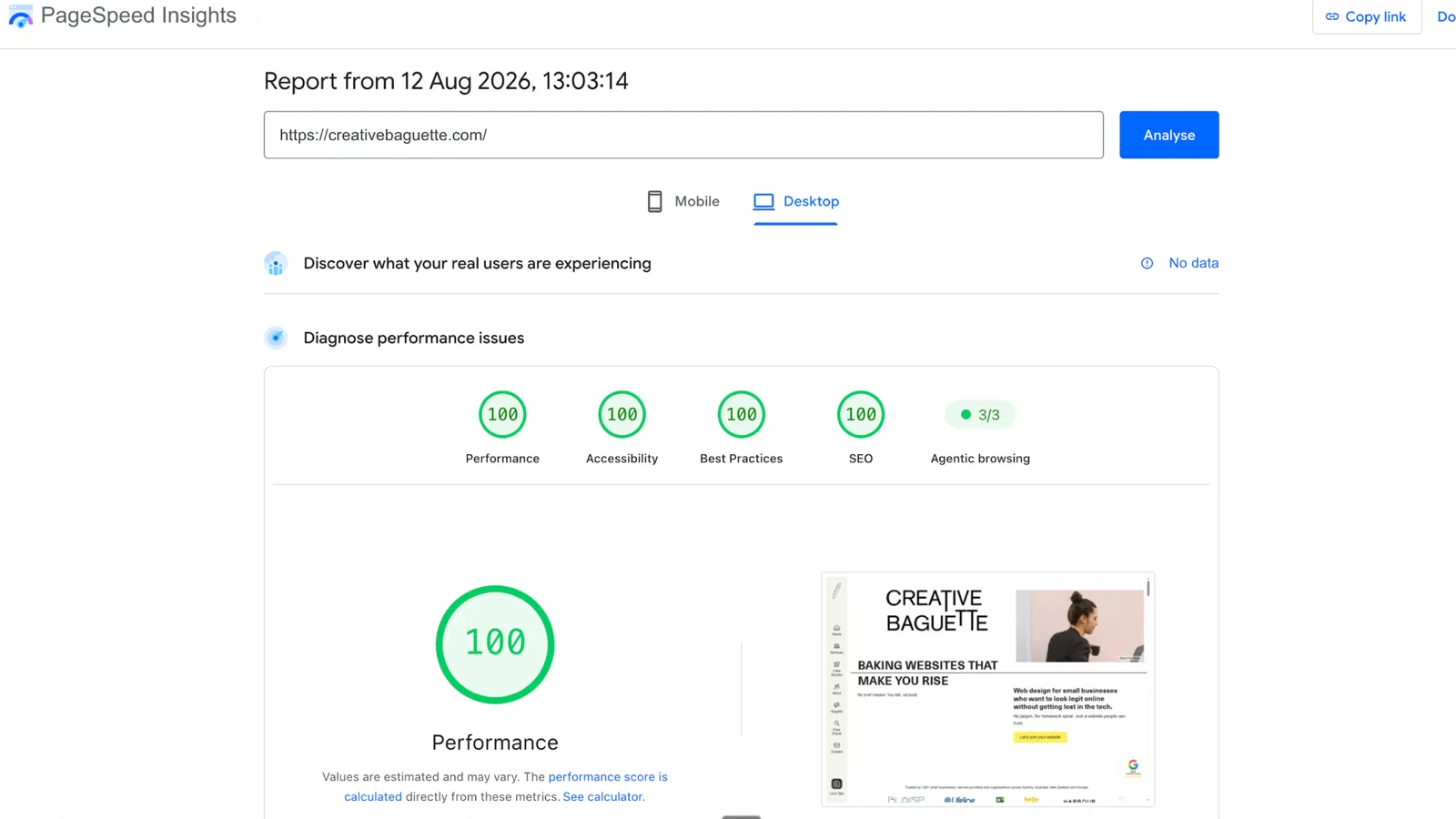
Fair question to ask a web designer. Here's our report from 12 August 2026:
Desktop: 100 for speed, 100 for accessibility, 100 for best practices, 100 for SEO.
Mobile: 98, then 100, 100 and 100.
Two caveats, because you'd find them out anyway. Scores wobble a point or two between runs, so treat any single test as a snapshot. And speed on its own won't bring you work. It removes a reason to leave. What makes someone stay is your words, your proof and your prices.
We chase it because every site we build sits on the same setup. Our own homepage doesn't get special treatment.
What actually makes a small business site slow
Almost always one of five things.
Photos straight off the camera. A 4MB photo on a phone is like posting someone a filing cabinet when they asked for a business card. Resizing your images is the biggest single win on most sites, and it costs nothing.
Plugin stacking. Every add-on brings its own code, and the browser has to read all of it before it can show your page. Eleven plugins to run a contact form and a slideshow isn't unusual, and it's why the page takes six seconds.
Cheap shared hosting. Your site sharing a server with three hundred others. It costs $4 a month, and it shows in the first second of every visit.
Old tracking scripts nobody checks. The tracking code from that campaign in 2023. The chat widget nobody replies to. The trial that ended. Each one still loads on every page, every time, forever.
Fonts and sliders. Six font styles when you use two. A rotating banner your visitors leave before the second slide. Both slow, both decoration.
So does Google actually care?
A bit. Google gives speed a little weight. Your customer gives it a lot.
Google's own research back in 2017 found that 53% of mobile visits get abandoned when a page takes longer than three seconds. It's an old number and it still gets quoted, because nobody has found evidence that people have become more patient since.
So treat this as a customer problem, not an SEO one. It's the difference between someone reading your services page and someone reading your competitor's.
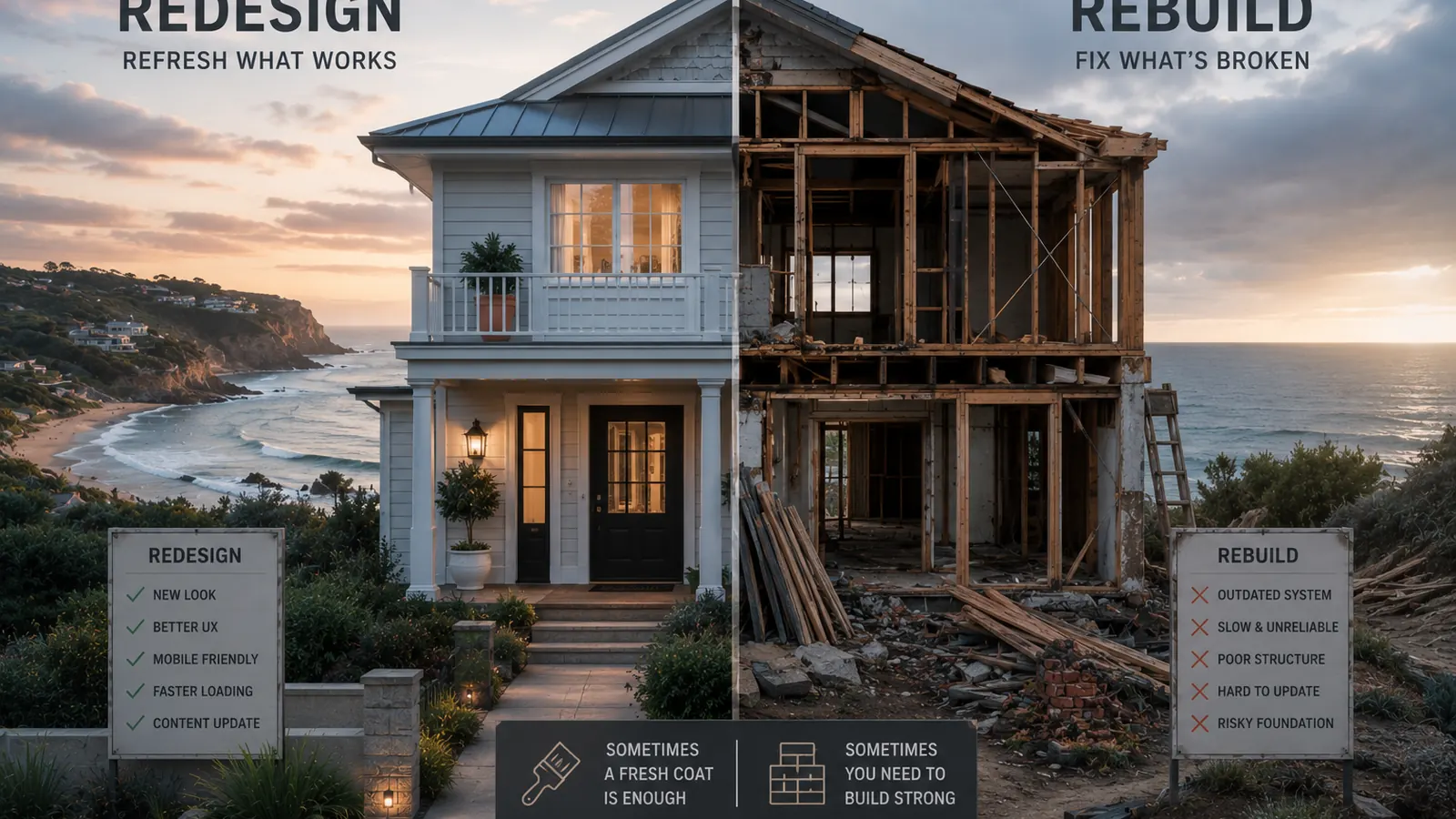
One caveat. If your site is slow and the words on it are vague, fix the words first. A fast page that doesn't explain what you do is just a quicker way to lose someone. We wrote about that in why small business websites fail, and if you're weighing up whether the site needs patching or replacing, redesign vs rebuild is the next one to read.